

Nur auf Englisch, mit Absicht. Deutsche Arbeit: Start →
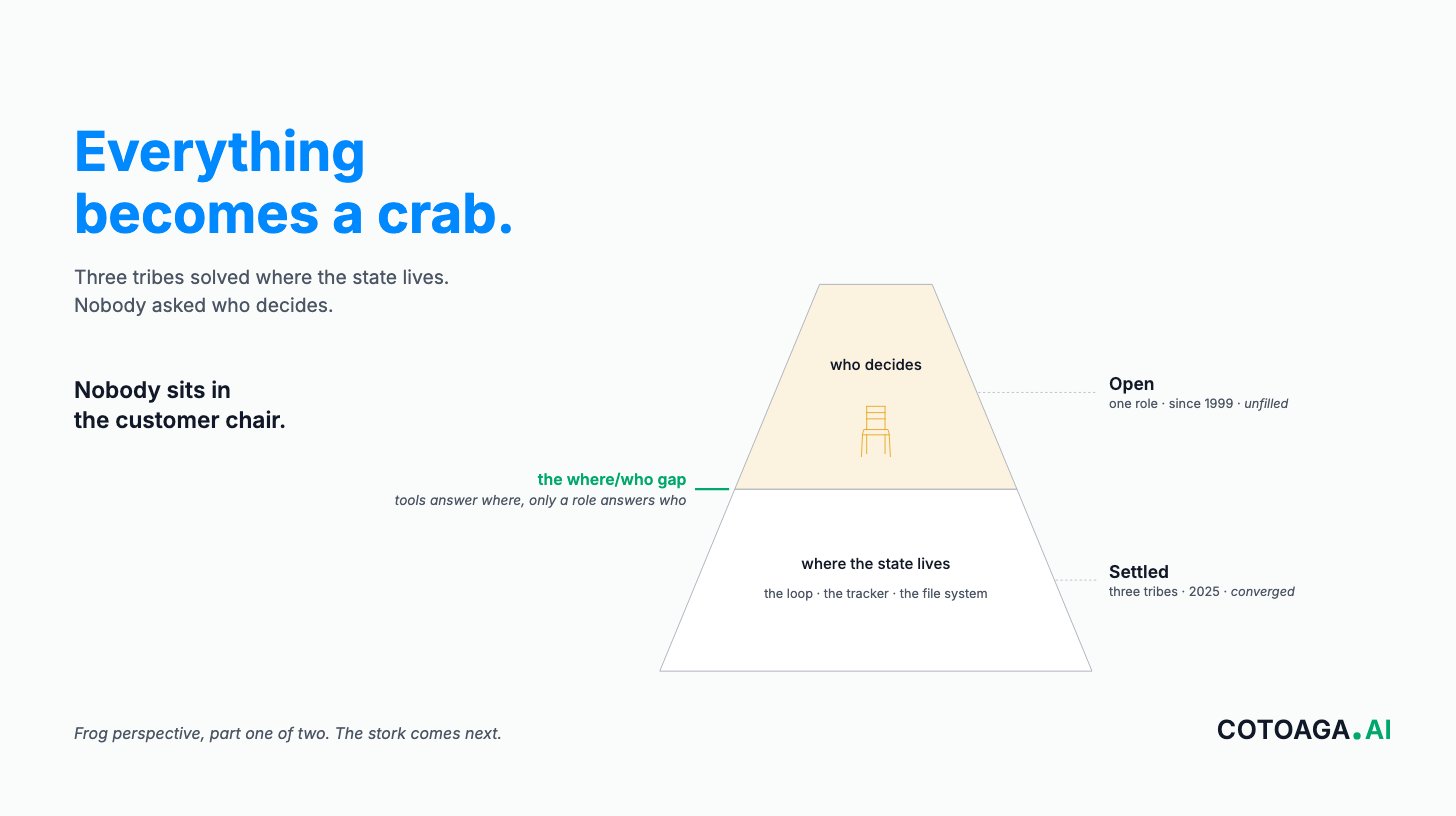
Frog perspective — part one of two. The stork comes next.
If you are seriously building with AI, you had this moment. Token spend goes through the roof. Not because you shipped more. Just so.
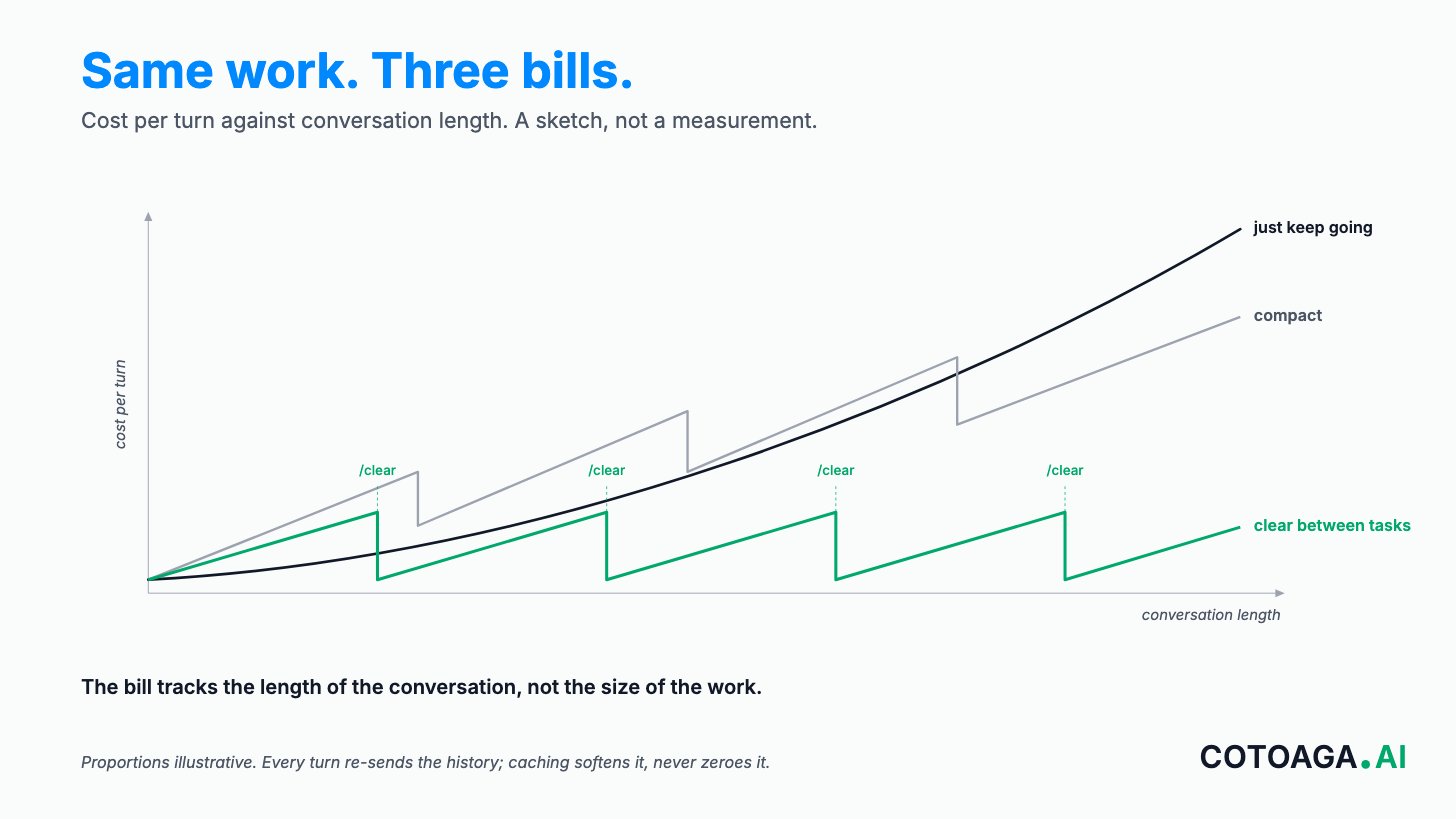
The bill tracks the length of the conversation, not the size of the work. Every turn drags the whole history along; caching softens it, never zeroes it, and past a certain length the output gets worse while the meter gets faster. A frog in warming water doesn’t jump. Neither did I — for weeks.
My fix wasn’t compression. I stopped compacting and started clearing: between tasks, every task, no exceptions. The bill dropped like it had been shot. It only worked because nothing I needed lived in the chat. That’s the whole trick, and I’ll leave it there.
Then I went looking for whether anyone else had landed in the same place. Turns out: everyone.
Three tribes, one shape
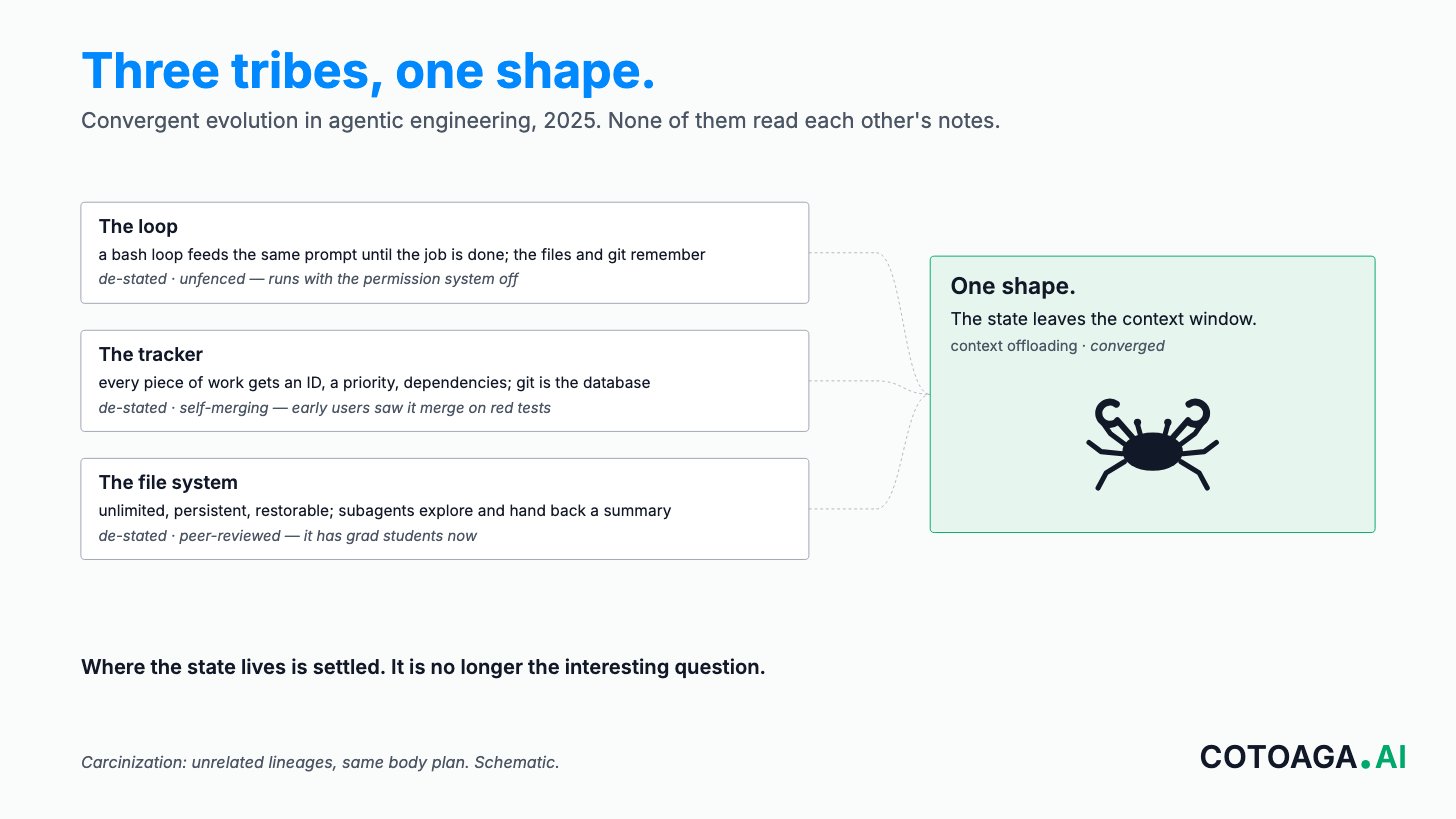
Biology has a word for this. Carcinization: unrelated crustaceans have evolved into crab-shaped bodies at least five separate times, independently, because the shape works. The internet shortened it to everything becomes a crab. Agentic engineering spent 2025 becoming a crab. Three tribes, none of whom read each other’s notes, grew the same body plan: the state leaves the context window and lives somewhere the agent can’t lose it. The field even named the move — context offloading.
State, in plain words: everything the work has to remember between one step and the next. What was decided. What’s done. What’s next. What broke last time and why. In a chat, all of that lives in the scroll-back — the agent re-reads it every turn, you pay for it every turn, and when the window gets compacted, pieces of it quietly disappear. Moving the state out means writing it down somewhere that doesn’t forget: a file, a ticket, a commit. The chat becomes disposable. The state doesn’t.
Tribe one: the loop. Geoff Huntley’s “Ralph Wiggum” technique is a bash loop that pipes the same prompt file into the agent — output, errors and all — until the job is done. The loop remembers nothing. The files and the git history remember everything. It went from a tweet to an official Claude Code plugin in half a year, and it only runs autonomously with the permission system switched off. Huntley says it himself: don’t walk away from it. Brutalist, honest, unfenced.
Tribe two: the tracker. Steve Yegge — forty years of software, ex-Amazon, ex-Google — hit the wall harder than anyone: hundreds of markdown files, competing and contradicting each other, and agents with, in his word, dementia. His answer was Beads: an issue tracker built for agents, where every piece of work has an ID, a priority, dependencies and an audit trail, and git is the database. Underneath, that’s a graph. Every node is one piece of work — “fix the login redirect,” “write the migration” — with its own status. Every edge is a relationship the agent would otherwise have to hold in its head: this blocks that, this was found while doing that, this is part of that bigger thing. The agent no longer scrolls back to work out what’s next. It asks the graph: what’s open, and what isn’t blocked? He calls the architecture crummy by pre-AI standards, in public, which is exactly why I trust him. Then he stacked a multi-agent orchestrator on top, and early users reported it merging pull requests over failing tests. Remember that detail.
Tribe three: the institutions. Manus treats the file system as the real context — unlimited, persistent, always restorable. Anthropic’s own engineering notes describe subagents burning tens of thousands of tokens in a fresh window and handing back a two-page summary. GitHub’s Spec Kit turned the pattern into structure. There are arXiv papers now on version-controlled markdown as agent memory. Once a technique has grad students, it’s no longer folklore.
So the where question is settled. Where does the state live? Not in the chat. Loop, tracker, file system — pick your crab.
The older question
Look at the shape once more. Every tribe built a tool. Every tool answers where. Nobody in the bucket asked the question that predates all of them: who decides what gets built next, and who says it’s done?
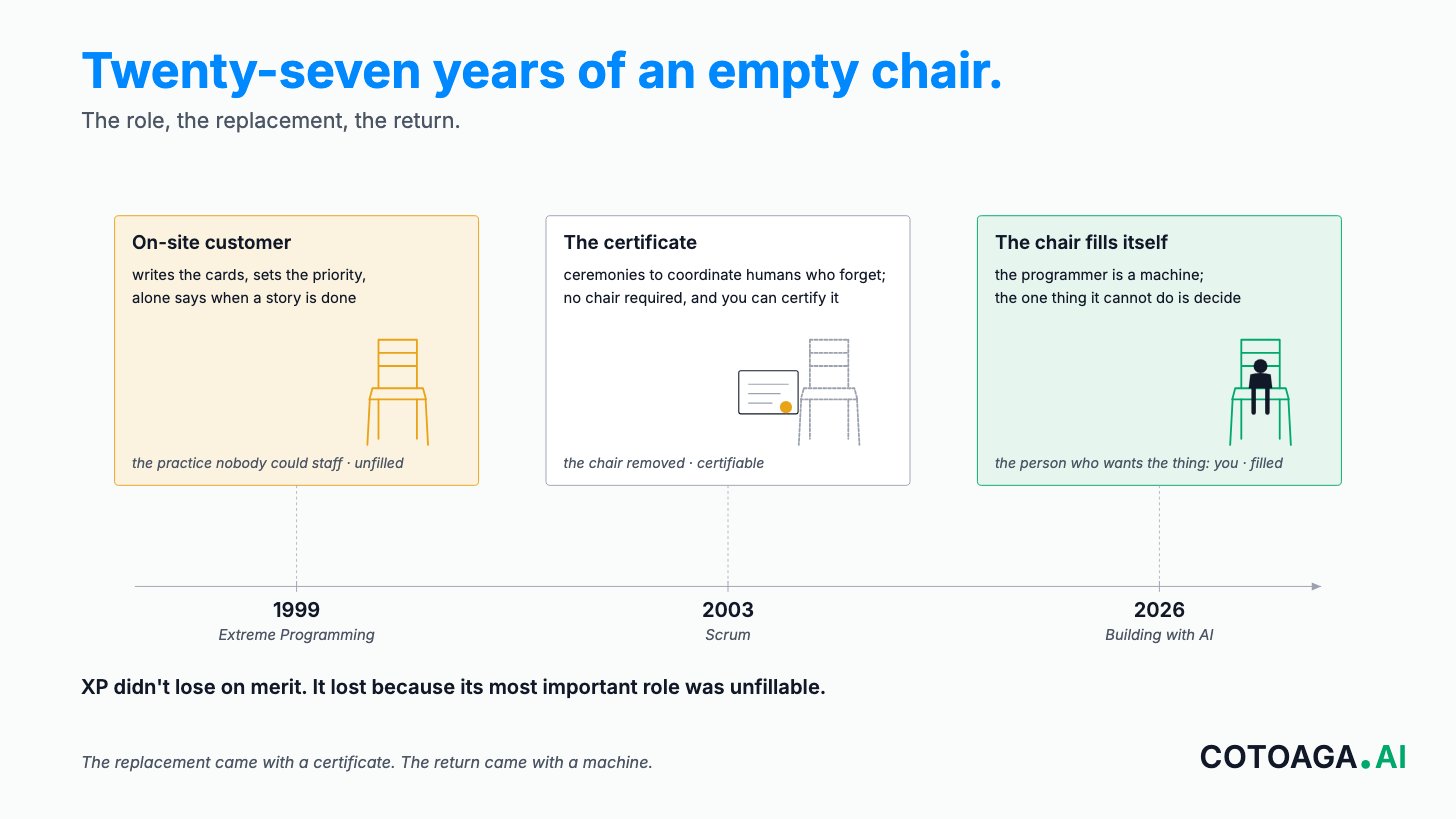
That question has an answer, and it’s twenty-seven years old. In 1999 Kent Beck published Extreme Programming Explained, and the hardest practice in the book was called On-Site Customer: a real customer sits with the programmers, writes the stories on index cards, sets the priority, and is the only person allowed to accept a story as finished. Not a proxy. Not a manager. The person who wants the thing.
It was the practice nobody could staff. Companies would not put a real customer in that chair, full-time, next to the code. The project XP was born on was cancelled in 2000, and the people who were in the room have written about that empty chair ever since. XP didn’t lose on merit. It lost because its most important role was unfillable — and because the methodology that replaced it didn’t need the chair and came with a certificate.
Here is the twist 2026 delivers for free: the chair fills itself now. The programmer is a machine. It ships in minutes, works nights, and forgets by morning. The one thing it cannot do — the thing every tool above quietly hands back to it anyway — is decide. What next. What’s done. Ralph’s loop stops when the agent promises it’s finished. The orchestrator merged when the agent felt ready. That’s a programmer accepting its own story, and Beck had a word for what happens next. It wasn’t “velocity.”
The customer seat isn’t a luxury anymore. It’s the only seat left. And the person who wants the thing is you.
A word for the ceremonies, respectfully, because they’re dead and deserve better than mockery. Scrum’s rituals were built to coordinate humans who forget. The trouble is that neither humans nor agents forget cleanly: the work fades, the ritual stays. An agent trained on twenty years of sprint retrospectives will run a flawless standup for a team of one. That isn’t agility. That’s cargo cult — wooden headphones on an island runway, waiting for the planes.
So yes: the cards are back. Small, written by the person who wants the thing, accepted by the same person, and never by the machine. What the chair needs in practice — how the cards are cut, what gets checked before anything counts, what the machine is mechanically forbidden to touch — is a longer conversation, and I’m having it with the people who ask. Beck’s book had another role, by the way, called Tracker. That one is the stork’s story.
The bucket
Carcinization has a second law. A bucket of crabs needs no lid: crabs, being crabs, keep each other in. That’s not malice. It’s shape — the body plan that got everyone into the bucket is the same one that makes climbing out over each other impossible. The tools are in the bucket, and they’re good tools. The customer was never in it.
Who’s sitting in your customer chair? If the answer is the agent, you already know how the story ends.
First published on LinkedIn, 17 Sep 2026. This edition adds one illustration and a few lines on state.
Postscript, October 2026
Today I know I'm using a graph. The graph is the natural evolution — again, the way unrelated animals independently arrive at the crab form, simply because it's fit for purpose. The graph extends the dumb prompt-response pattern the prompt monkeys of 2026 rely on (see the AI-Literacy Pyramid, L1b), and it extends the loop the LLM companies are pushing so hard.
At its core, the graph can describe far more complex agent orchestrations. For that it needs nodes, edges and explicit state. Of course a graph can also draw prompt-response or a loop — put either next to a working orchestration graph, and you see the difference instantly.
A graph is still a crab. It settles where the state lives — it doesn't sit in the customer chair. That one is still mine.
Created Updated