
Nur auf Englisch, mit Absicht. Deutsche Arbeit: Start →
Where eight billion people actually stand — and why 2026 became the year everyone is an expert.
Last time I put every AI position you can hold on one board and showed where accountability cannot migrate. This time the question is simpler and less comfortable: the people who are supposed to carry that accountability — where do they actually stand?
2026 is the year everybody and their grandmother became an AI expert. You have seen the headlines. AI Strategist. AI Transformation Lead. Certified AI Manager. Some of these people spent a decade in the field. Most got their certificate in an afternoon, and the certificate is real. It says so on the wall.
I don’t argue with headlines. I count.
The board
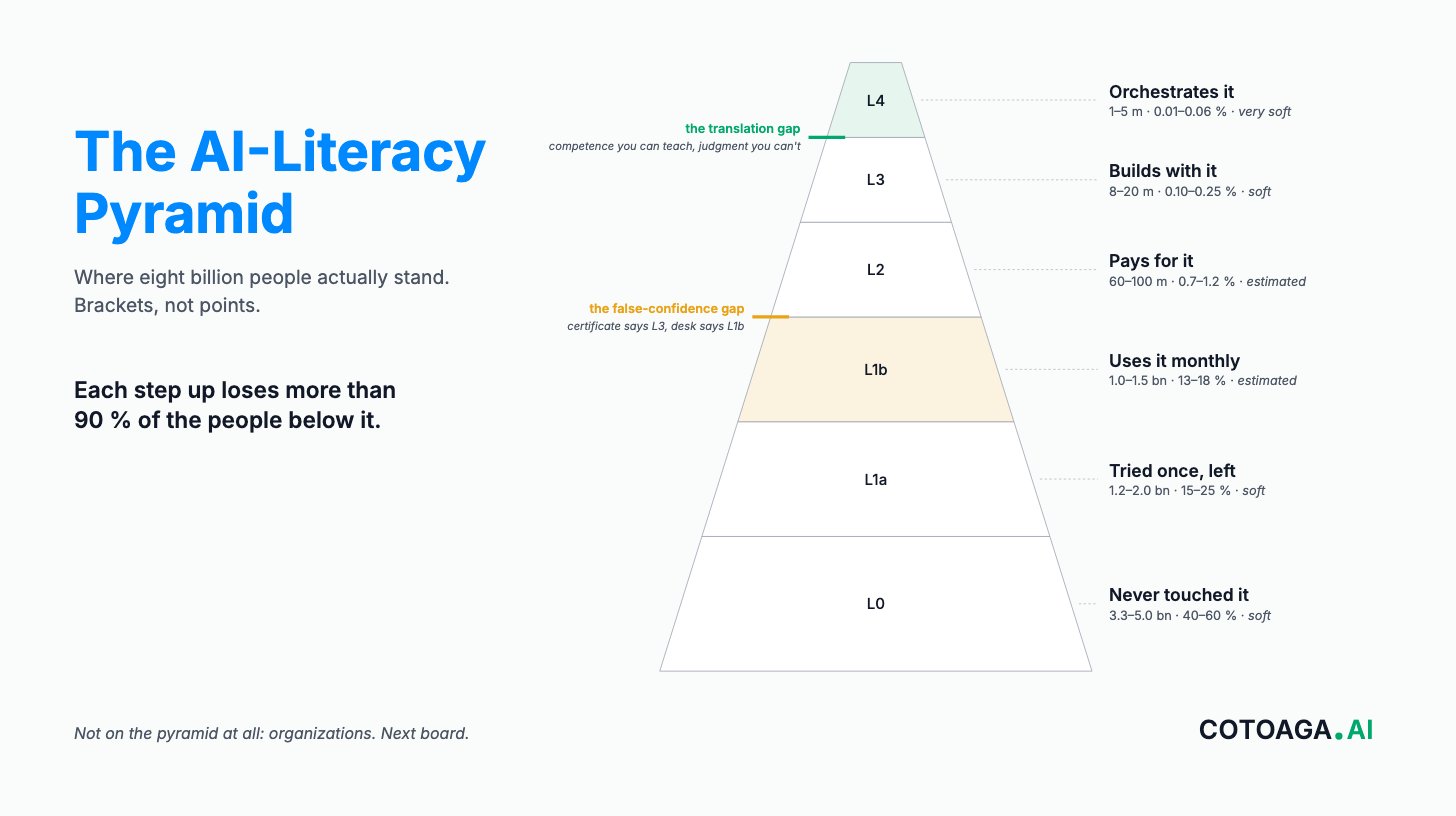
Five levels, six layers, all of them people. The numbers are brackets, not points, because nobody measures this directly — every figure below is a synthesis across sources that don’t fully overlap. I’ll tag what’s firm and what isn’t.
L0 — Never touched it. Roughly 40 to 60 percent of humanity, three to five billion people. Soft number, modeled from adoption surveys. The barber with the paper appointment book. The construction firm with the 2010 Excel sheet. To them AI isn’t moving too fast. It isn’t moving at all.
L1a — Tried once, walked away. 15 to 25 percent, over a billion people. Soft number, inferred from the gap between “ever used” and “used this month.” Opened a chatbot, got one wrong answer, went back to Google. Their diagnosis: this thing isn’t reliable. The accurate diagnosis: nobody told me how it works.
L1b — Uses it monthly. 13 to 18 percent, one to one and a half billion. Estimated, anchored by vendor disclosures. Birthday captions, grammar checks, a draft email. Treats it like a search engine. Trusts it about as much as a search result — uncritically when it agrees, suspiciously when it doesn’t.
L2 — Pays for it. Under one and a half percent. Sixty to a hundred million people worldwide, once you deflate for people paying twice. Estimated. Has a working relationship with at least one model. Has opinions. “Claude for this, ChatGPT for that.” Has noticed that the free tier is a different product.
L3 — Builds with it. A quarter of a percent at most. Eight to twenty million. Soft — constructed from paid coding-assistant seats, automation-platform users, and internal teams calling APIs, none of which are the same population. Understands context windows, model selection, tokens. Can check output against ground truth because they built the thing that produced it.
L4 — Orchestrates it. Somewhere between one and five million. Very soft; this tier has no public metric at all, and that absence is its fingerprint. Runs several systems at once, none of which can see each other. Holds three contexts in one head and makes the call when they disagree. The human is the integration layer. Nobody trained them. They arrived by practice.
There is no L5. Above L4 the air is too thin for a tier, and the next question isn’t about individuals at all. I’ll come back to it.
The shape
Look at the drops. From “uses it monthly” to “pays for it” is a factor of ten to twenty. From “pays” to “builds” another five to ten. From “builds” to “orchestrates” another five. Each step up loses more than ninety percent of the people below it.
That is the steep part, and it’s why the year of the experts produces such strange numbers. There are perhaps twenty million people on Earth who build with these systems and a few million who orchestrate them. There are considerably more people than that with AI in their job title.
The arithmetic has only one resolution: most of the experts are standing at L1b with a certificate.
That is not an insult. It’s a coordinate. L1b is a fine place to be — the tools are useful there, and the cost of being there is zero. The cost starts when the certificate says L3 and the desk says L1b, because the gap between where you are and where you think you are is not ignorance. Ignorance is cheap; it asks questions. The gap is false confidence, and false confidence signs things.
Two gaps that matter if you run a department
There are three cliffs on this pyramid and a decision-maker only needs to know two of them.
The false-confidence gap, between L1b and L2. This is where the Führerschein crowd works — the driving-licence people, sixty minutes to AI readiness, certificate included. I’m using the German word because the German market is where I watch it happen. Their business depends on the graduate staying at L1b while believing they’ve reached L3. The workshop ends. The CRM data is still broken from February. The certificate is on the wall. Nothing moved except the belief.
The translation gap, between L3 and L4. The hardest one. L3 is technical competence and you can teach it. L4 is judgment across systems, and you can’t — not in a course, not in a framework, not in a certification. It’s pattern recognition built by watching several technology waves fail in the same shape with different vocabulary. “Build it in an afternoon” dies here. The afternoon builds the tool. The decade builds the judgment about what to build.
There’s a third crowd that lives on this pyramid, and they deserve a name because they are the mirror image of the first: the Fahrverbotcrowd — the driving-ban people. “Unless you understand loss functions you have no business deciding about AI.” They are technically right and strategically useless. Their effect on a Bereichsleiter is learned helplessness: I’ll leave this to the experts. Which experts? See above.
One sells you the licence. The other explains why you may never drive. I want the thing to drive.
What the pyramid doesn’t do
It doesn’t certify. The moment L2 gets a badge, there’s a licence market. The moment L3 becomes a prerequisite, there’s a gate. Every certification ladder I have watched over thirty-five years started as a capability model and ended as a revenue model. This one stays a diagnostic.
It doesn’t rank people. A department head who can’t write a prompt can make better AI decisions than an L3 engineer who has never run a P&L — if someone removes the driving ban and hands him the three questions that matter instead of thirty formulas. The pyramid measures competence in a domain, not worth.
And it doesn’t hold still. I published the first version of these numbers in April with 84 percent at the base. Within weeks that figure was stale — the base had shrunk, the paying tier had roughly tripled, the building tier had roughly quadrupled. The cohort grew; the framework didn’t. So the numbers now carry tags, and the tags are the point: firm, estimated, soft. If a chart about AI literacy doesn’t tell you how much it trusts itself, it’s teaching the wrong lesson.
Back to the board from last time
Accountability cannot migrate to the machine. Someone answers for the output. The pyramid tells you at what altitude that someone stands — and you cannot answer for what you cannot judge. The frameworks all draw the box where a human is supposed to judge. None of them checks whether he can.
Outlook: now put an organization on it
Everything above is about individuals, and the pyramid should stay that way. An organization isn’t a point on it. It’s a distribution across it — a few hundred people at L0 and L1, a handful at L2, maybe one L3 in IT who nobody asks.
The interesting number is not the organization’s best level, and not its average. It’s the level at the point of signature. Whoever signs the vendor contract, approves the pilot, or countersigns the compliance statement — that person’s altitude is the organization’s altitude, for legal purposes. Article 4 of the EU AI Act asks deployers for sufficient AI literacy. It doesn’t say where to measure. I would measure at the signature.
I have started drawing that second board. Two things are already visible. Literacy and decision rights run in opposite directions on most org charts — the higher the floor, the lower the tier. And every vendor conversation is an L3 talking to an L1b, and the L1b signs.
The word I keep writing in the margin is devastating. I’m not using it for effect. That’s the next article.
The pyramid doesn’t measure how much you know about AI. It measures how much AI can fool you — and whether anyone in your building can tell the difference.
Method note: tier brackets are from the cotoaga.ai AI-Literacy Pyramid v1.1 (April 2026), synthesized from Stanford HAI 2026 AI Index, DataReportal Digital 2026, Microsoft Global AI Adoption 2025, OpenAI and GitHub disclosures, and the Anthropic Economic Index. Confidence tags per tier: soft / estimated / firm. The image that started the count was Damian Player’s February 2026 dot grid of 8.1 billion people. No tier has moved by more than its bracket since April.
First published on LinkedIn, 12 Sep 2026.
Created Updated