

Nur auf Englisch, mit Absicht. Deutsche Arbeit: Start →
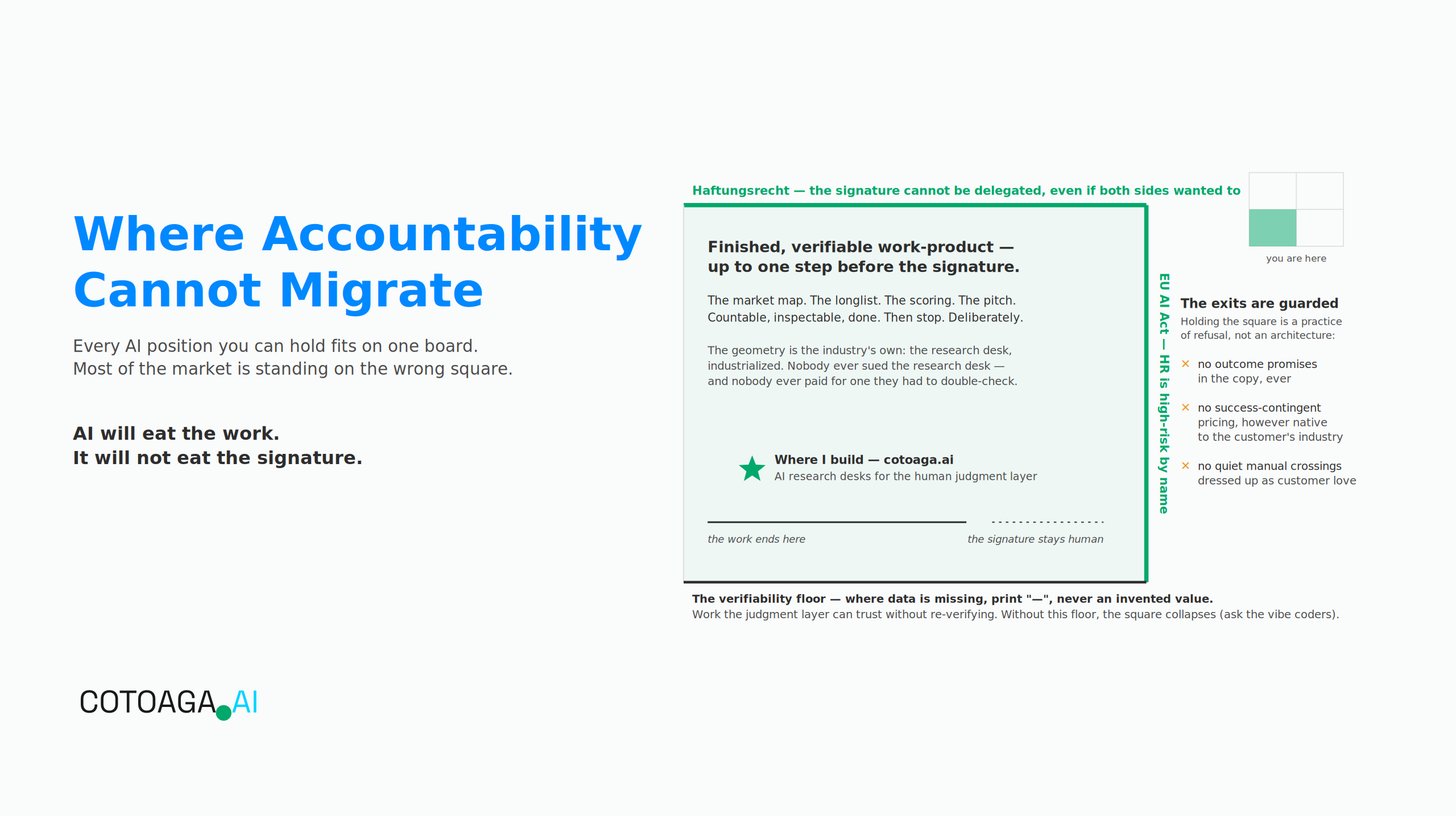
Every AI position you can hold fits on one board. Most of the market is standing on the wrong square — or not on the board at all.
You know these characters.
The tool with a sliver of AI — software from three years ago with a text box stapled to it, sold as transformation. Seats priced, roadmap "AI-first," accountability nowhere in the contract.
The prompt monkey — at one of the Big Five, gunning for AI User of the Month, because that's now a thing consultancies measure. Measured on prompts fired, decks generated, adoption dashboards. Measured on usage — never on work answered for.
The vibe coder — loops the model until it compiles, ships code they couldn't have written and can't quite read, and calls the velocity a business model.
The AI nihilist — wants none of it. Bills honest hours, answers for every line personally, and waits for the circus to leave town.
Every one of these positions feels unstable right now, and the people holding them know it. But ask why and you get capability talk — models improving, models plateauing, models hallucinating — as if capability were the variable that decides who survives. It isn't. What's missing is not another take. It's a map.
Two questions
Forget what the model can do. Ask two contractual questions instead.
What do you answer for? Finished units of work — the research, the list, the draft, the analysis? Or the outcome — the placement, the closed books, the settled claim?
What are you priced on? The labor you replace, by the hour or the unit? Or the value of the outcome — a success fee, a share of the result?
Two questions, two axes, four squares. Everything in the menagerie above has an address on this board — or is revealingly absent from it.
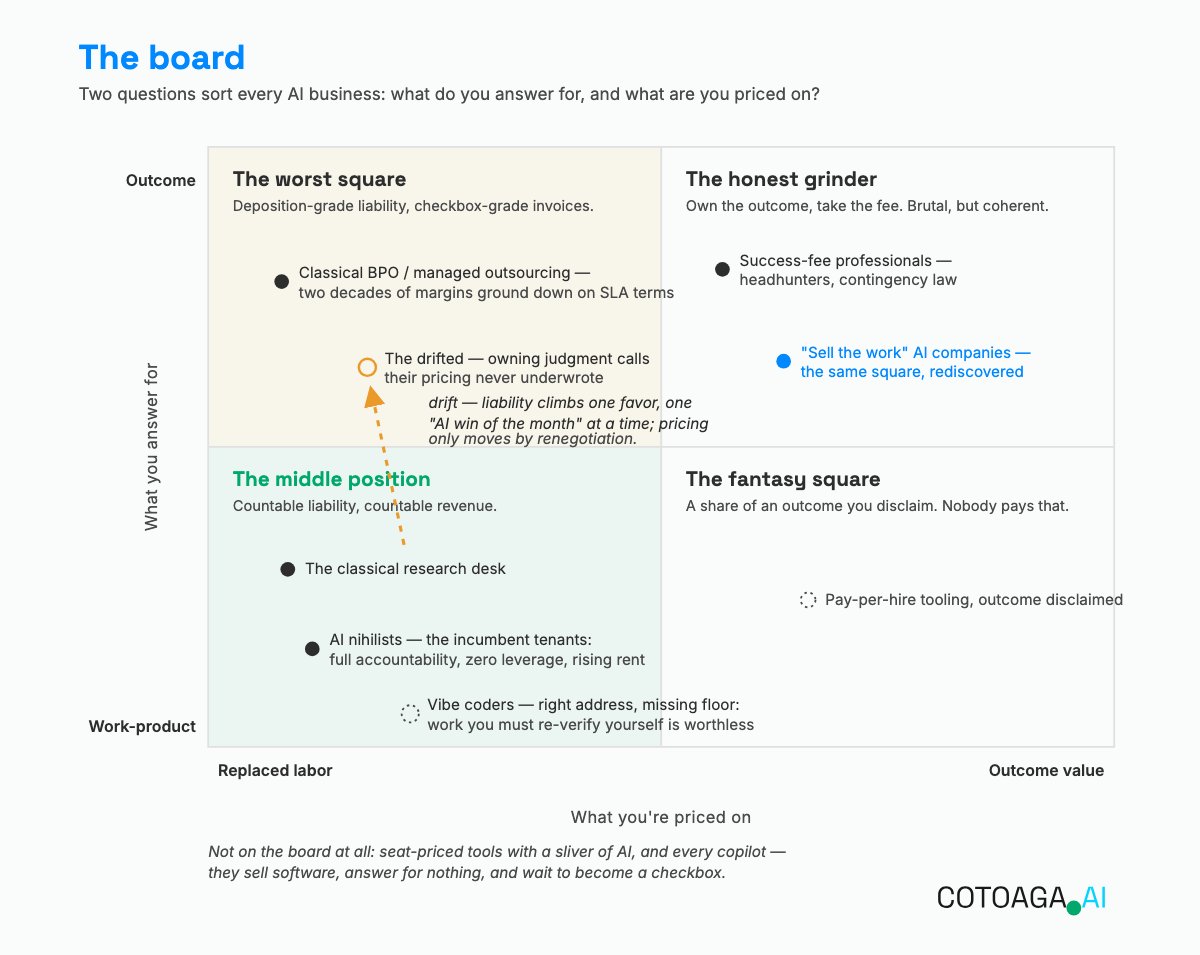
Bottom-left — work-product liability, labor pricing: the middle position. Countable liability, countable revenue. You answer for "did you deliver fifty verified, scored targets," and you invoice against the hours that replaced. This square has incumbents: every research desk, every paralegal pool, every analyst team that ever existed. The AI nihilist lives here too — has always lived here, honorably. Their problem isn't position. Their problem is that the rent just changed: same square, same full accountability, suddenly uncompetitive cost curve.
The vibe coder thinks they live here. Right address, missing floor: work-product is only work-product if the layer above can trust it without re-doing it. A deliverable you must re-verify yourself is not a deliverable — it's a suggestion with an invoice. Hold that thought; the floor comes back later.
Top-right — outcome liability, value pricing: the honest grinder. Own the outcome, take the fee. Headhunters on success fees, contingency lawyers, every no-win-no-fee shop in history. Brutal economics, coherent contract: the liability and the pricing point the same direction.
Bottom-right — the fantasy square. Work-product liability at value pricing: a share of an outcome you contractually disclaim. Customers are not idiots. Nobody pays a percentage of the placement to someone whose terms say the placement isn't their problem. Structurally empty, permanently.
Top-left — the worst square. Outcome liability at labor pricing. Deposition-grade risk ("was this a good placement?") on checkbox-grade invoices ("units delivered"). Full downside of owning the judgment call, revenue capped at replaced hours.
And the characters who aren't on the board at all: the tool with a sliver of AI, and every copilot. They sell software into a software budget and answer for nothing — which sounds safe until you notice it means they're not playing this game, they're waiting to become a checkbox in someone else's model release.
Which leaves the prompt monkey. They're not a square. They're an arrow — and the arrow is the most important thing on the board. Every unverified deck the prompt monkey generates moves a little liability upstairs, toward the partner whose signature still binds, while the pricing of that signature stands exactly still. Usage metrics reward the motion; nobody prices it. Cory Doctorow calls this creature the reverse centaur — the human bolted onto the machine as its exhaustible appendage. The prompt monkey is a reverse centaur with a lanyard, and the arrow they ride points straight at the worst square.
The square that predates AI
If the worst square sounds theoretical, ask the outsourcing industry. Classical BPO spent two decades holding exactly that position: SLA-grade outcome liability — uptime, resolution rates, penalties — on FTE-hour pricing. The geometry predicts a slow grind of margins, disputes over definitions of "done," and clients who capture every efficiency gain while the provider keeps every long-tail risk. That is precisely what happened.
The board is not an AI take. It explained the outsourcing squeeze before the first transformer was trained. AI didn't create these squares; it just changed the rent on all of them at once — which is why everyone on the board feels the floor moving and almost nobody can name the mechanism.
The trillion-dollar argument is two squares shouting
Now the debate currently eating the venture feeds. In March 2026, Sequoia's Julien Bek published the thesis: the next trillion-dollar company won't sell software tools — it will sell the work itself. Stop fighting over a software budget AI is busy deflating; capture the services budget, which is several times larger. A month later, Pankaj Bhalerao published the rebuttal the thesis deserved: owning outcomes at scale is an economic grinder. The long tail never goes away. Success definitions turn disputable, attribution turns political, human fallback queues eat the margin.
Put both on the board and the fight shrinks to its actual size. The thesis says: leave the off-board tool position, move to the honest grinder — the money is bigger there. The rebuttal says: the grinder grinds — look at the failure catalog. Both are right. Both are arguing about exactly two squares, blind to the other two. Neither names the position the durable companies of this cycle are actually being built on.
Why the middle dodges the grinder
Walk the rebuttal's catalog and notice that every failure mode derives from owning the outcome.
Disputable success? "Was this a good placement" is a deposition. "Did you receive fifty scored target companies" is a checkbox. Work-product is countable; outcomes are litigable. Choose what you invoice accordingly.
The long tail? The autopilot must either solve it (nobody has) or eat it (fallback labor, margin gone). The middle position does something cheaper and more honest: it signals it. Where the data doesn't support a claim, the product says so — and routes the case to the judgment layer. The long tail doesn't disappear. It gets handed, visibly, to the person institutionally required to handle it anyway.
Which reframes the "mandatory human fallback" the rebuttal correctly identifies as the margin killer. In the middle position, the human layer isn't your fallback labor. It's your customer — doing the highest-value part of their own job, with radically better inputs. Same human, same judgment, on the right side of the invoice.
Attribution wars? You're causally linked to the value but contractually separate from the outcome — priced against replaced hours, not against a share of a fee whose causation nobody can prove. The customer keeps the upside. You keep a cost curve that tracks your revenue curve.
Team Thesis will object: work-units commoditize even faster than outcomes. Every model release makes "research plus scoring" cheaper to replicate. Correct — which is why capability is the wrong foundation for this position too. On capability arguments alone, the middle buys you maybe a year.
Which is exactly why capability isn't the argument.
The line that doesn't move
Ask why the human judgment layer persists, and the comfortable answer is "humans do what humans do best." Comfortable, and worthless on a five-year horizon: the capability line moves every quarter, and betting a company on where it sits today is betting on weather.
Here is the line that doesn't move: institutions require a responsible counterparty. Professional services — law, audit, medicine, insurance, recruiting — are not organized around who can do the work. They are organized around who answers for it. A license. A client relationship. A neck on the block. That structure lives in liability law, professional codes, contracts, and insurance policies, and it changes at the speed of legislation — not at the speed of model releases. In Europe it is currently moving in the opposite direction from the autopilot thesis: the EU AI Act explicitly hardens human oversight for high-risk systems, and HR — recruitment and employment decisions — sits in its high-risk class by name.
Position yourself where accountability cannot migrate, and the outer wall of your moat is liability law, not model capability. Capability moats erode quarterly. Liability structures erode on decade timescales — and in Europe, right now, they're thickening.
The saddle point
Now the uncomfortable part, because the middle position is not an equilibrium. It's a saddle point with gravitational pull toward both ends — the arrow from the board, drawn at company scale.
Customers pull you toward the outcome one perfectly reasonable favor at a time. "Just tell me which candidate to send." "Can you draft the client email too?" "Why don't you contact them directly?" Each request is locally sensible. Each moves a judgment call across the line. Accept enough of them and you wake up an outcome company — with outcome liabilities and work-product pricing. The worst square, entered through the service door.
And builders slide without being pulled. I catch myself doing it: early customers, high-touch phase, and I'm personally making calls by hand that belong on the customer's side of the line. Call it concierge drift. It feels like service. It is, in fact, scope creep across the accountability line, executed personally, invisible right up until the pricing model has to underwrite it.
Holding the middle is therefore not an architecture. It's a practice — a practice of refusal. Three prohibitions, permanently in force: no outcome promises in the copy. No success-contingent pricing, ever, no matter how native it is to the customer's own industry. No quiet manual crossings of the line dressed up as customer love.
The worthy square
So where is the middle position worth holding — where are the walls thickest, the floor buildable, the incumbents' geometry already proven? My answer, from my own practice: HR.
I build AI work-product systems in exactly the field the EU AI Act names high-risk, for German Personalberater — headhunters. Germany is a beautiful test bed because German professional-services culture is unusually explicit about Haftung: liability, responsibility, the signature that binds. The recruiter cannot delegate responsibility for a placement to a software vendor even if both sides wanted to. The signature is legally and commercially load-bearing. In this field, the middle position isn't a strategy someone chose. It's written into law.
So I built to the line and stopped. The system scans the candidate, researches the market, scores the fit, prepares the pitch — finished work-product, delivered — and hands over. Where data is missing, it prints "—" instead of an invented value, because a judgment layer is only usable if it can trust what's underneath it. That's the floor the vibe coders are missing, poured on purpose: work you can hand upward without the layer above re-verifying it. The recruiter stays the recruiter.
The industry already knows this geometry. Classical Personalberatung always had a research desk: researchers built the market maps and the longlists, consultants owned the relationship and the close. Nobody ever sued the research desk over a failed placement. And nobody ever paid for a research desk whose lists they had to double-check. That's the whole position, pre-existing in the industry's own history — now industrialized.
One honest limitation, so this doesn't read as a victory lap: priced against replaced labor, the anchor deflates as labor gets cheaper. The durable version of the link migrates from "cheaper than your hours" to "work you can trust into your judgment without re-verifying it." In the long run, calibrated trust is the product. The work is merely how it's delivered.
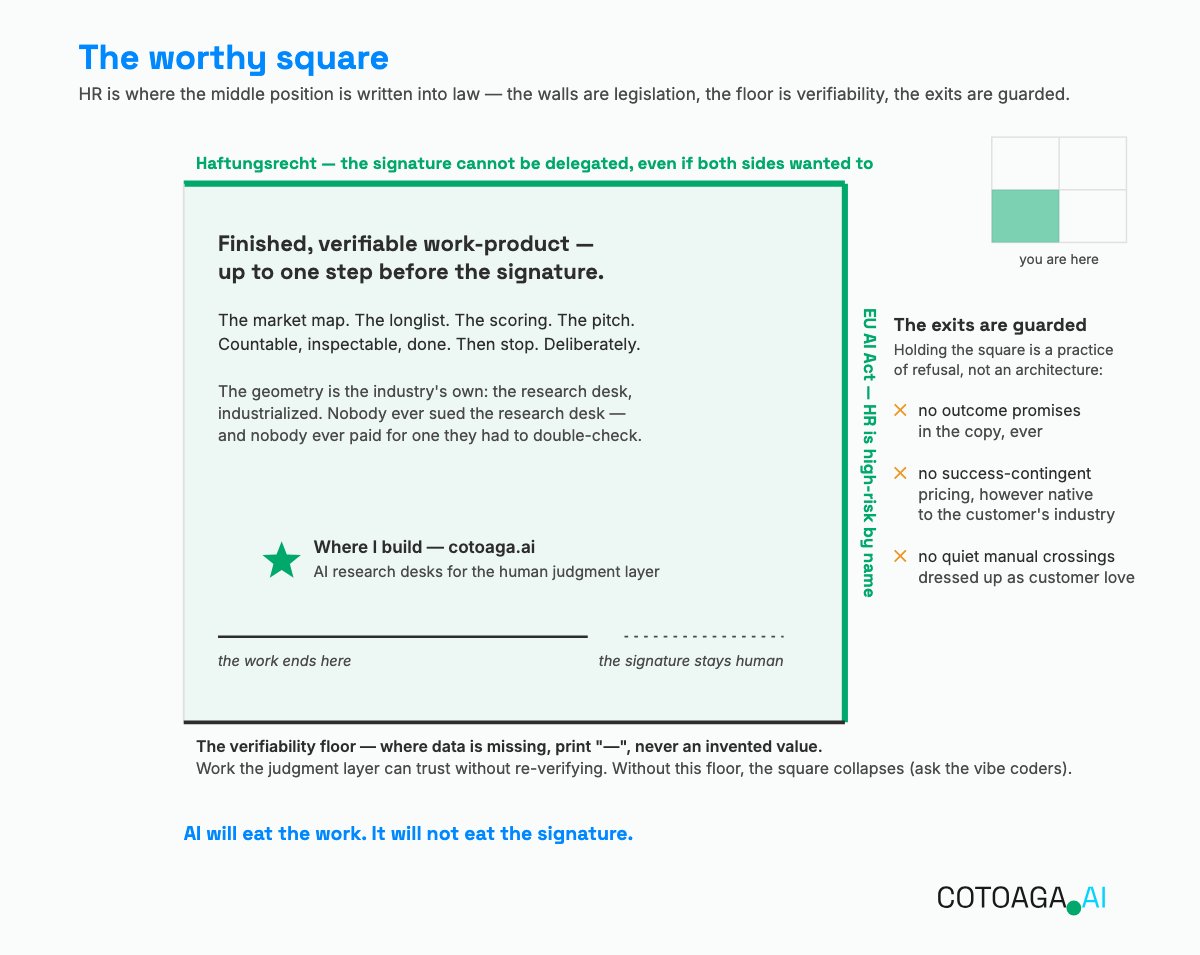
The thesis is right about the money: it's migrating from software budgets to work budgets, and pricing against labor is the correct anchor. The rebuttal is right about the grinder: owning outcomes at scale is a structurally brutal business. The synthesis neither side is naming: the durable position sells finished, verifiable work up to the accountability line — and has the discipline to stop there.
AI will eat the work. It will not eat the signature.
Build where accountability cannot migrate.
First published on LinkedIn, 9 Sep 2026.
Created Updated