

Nur auf Englisch, mit Absicht. Deutsche Arbeit: Start →
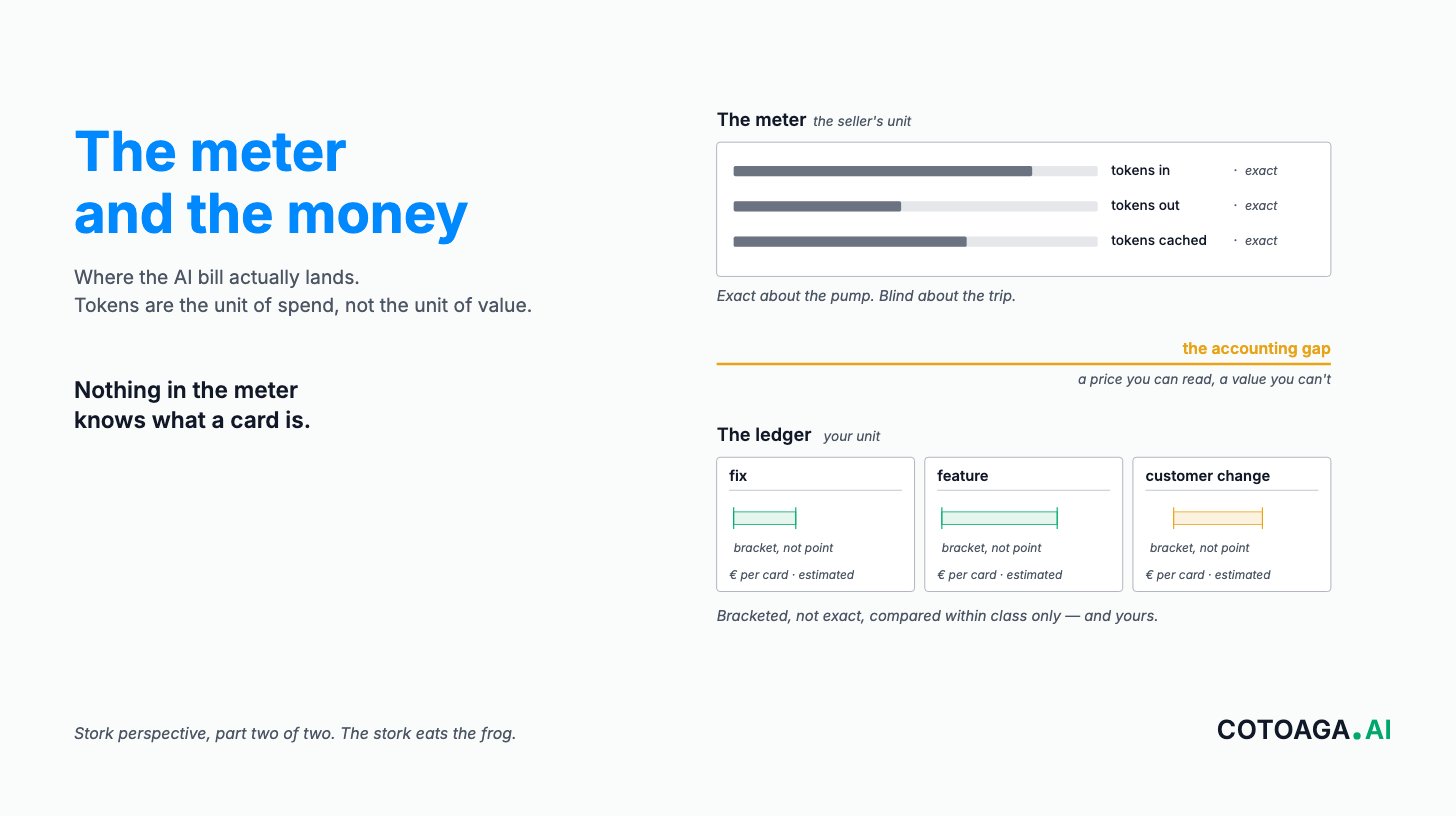
Stork perspective — part two of two. The stork eats the frog.
If you are seriously running a company that builds with AI, you had this moment. The bill arrives. It’s up again. And someone — your co-founder, your investor, the voice in your own head that does the books at night — asks what you got for it.
You have a number. It’s in millions. Tokens. No answer.
Yesterday I wrote as the frog: the builder in the pond who noticed his bill tracked the length of his conversations, not the size of his work, and fixed it by clearing between tasks. Good frog. From up here it changes nothing. A cheaper token spent on the wrong card is still the wrong card. The stork eats the frog.
The industry is fixing the meter
In August the Linux Foundation launched the Tokenomics Foundation — thirty founding members deep, cloud providers and consultancies and at least one bank, with the FinOps crowd alongside — and these days (22–23 September) it helds its first conference in Amsterdam. The mission is honest and useful: make token spend legible across vendors. FOCUS, the FinOps billing standard, already carries columns for tokens in, tokens out and tokens cached. Goldman expects token consumption to grow more than twenty-fold by 2030. Jim Zemlin’s line for the launch was that tokens have become the new unit of technology spend.
Of spend, yes. Of value, no. That isn’t a quibble; it’s the whole article.
Why a better meter can’t answer your question
The token is the seller’s unit. Two vendors tokenize the same sentence into different counts. Caching moves the count without moving the work. A model bump changes the price and the count on a Tuesday while the thing you were building stays identical. An agent exploring a codebase burns tokens by the hundred thousand and never touches the product — the receipt is real, the work is nil.
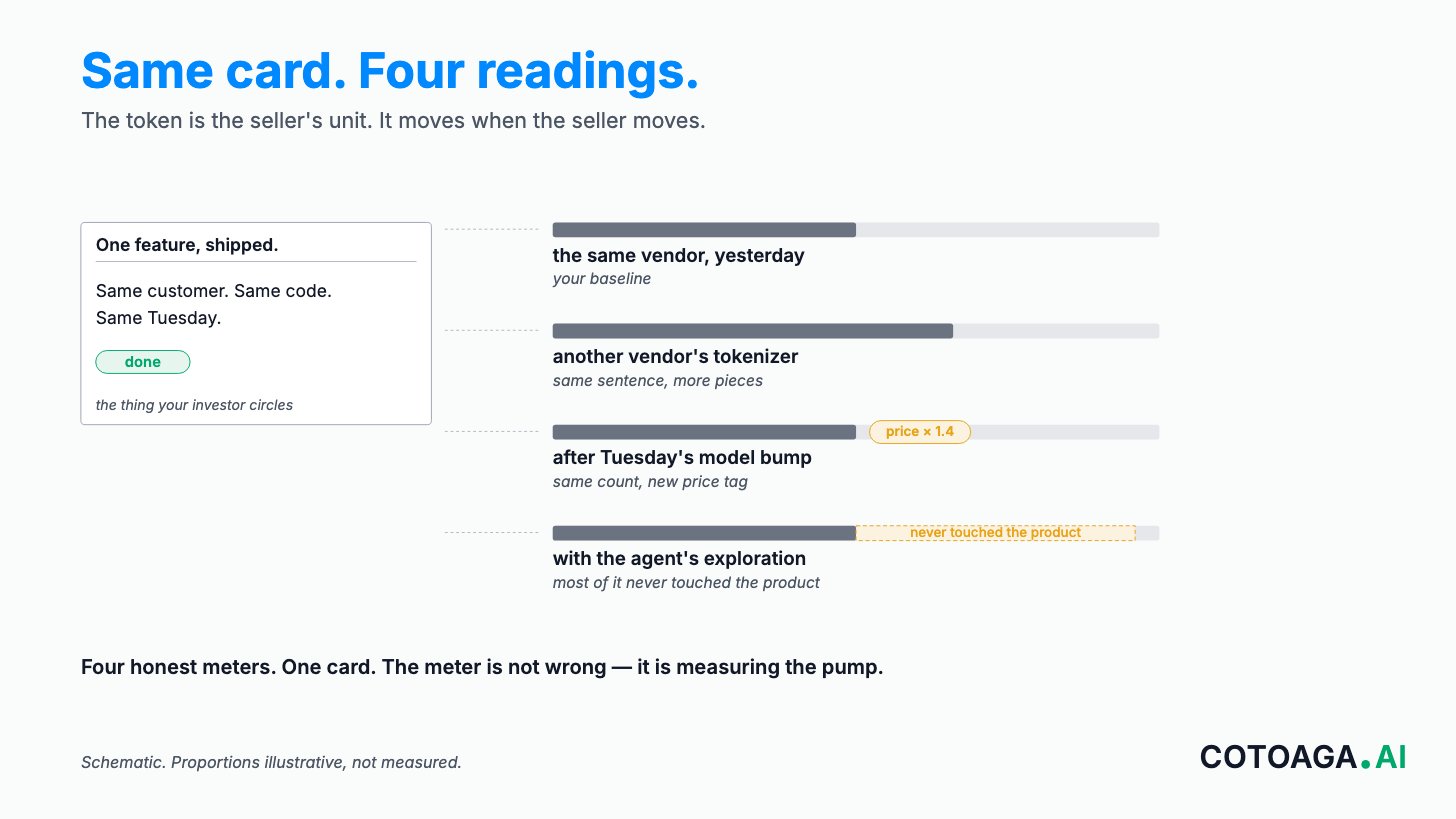
Standardizing that readout across vendors is real progress and I hope they finish it. But it standardizes the pump. Your money — the line on your P&L that your investor circles — is spent on things shipped: a feature, a fix, a change a customer asked for. Nothing in the meter knows what a card is. The meter is exact about the pump and blind about the trip.
The Tracker returns
Twenty-seven years ago Kent Beck’s Extreme Programming Explained described a role nobody talks about. The book is remembered for the customer — the person who writes the stories on index cards and alone says when one is done. Another role was the Tracker: the person who kept estimates against actuals, card by card, and fed the real prices back into the planning game so the customer chose with open eyes. The team’s conscience. And the first job every team dropped, because it was bookkeeping, and nobody joins a startup to keep books.
In 2026 the Tracker is a machine too. The programmer forgets by morning, so the counting can’t live in anyone’s memory. It lands on the card the moment the card closes, in currency, without anyone remembering to write it down. What that takes in practice is small and boring and I’m not going to spell it out here; the point is the unit, not the plumbing. The unit of account is the card. Tokens become the receipt stapled to the back — read it when a card cost twice what you expected, never manage by it.
What my own ledger says
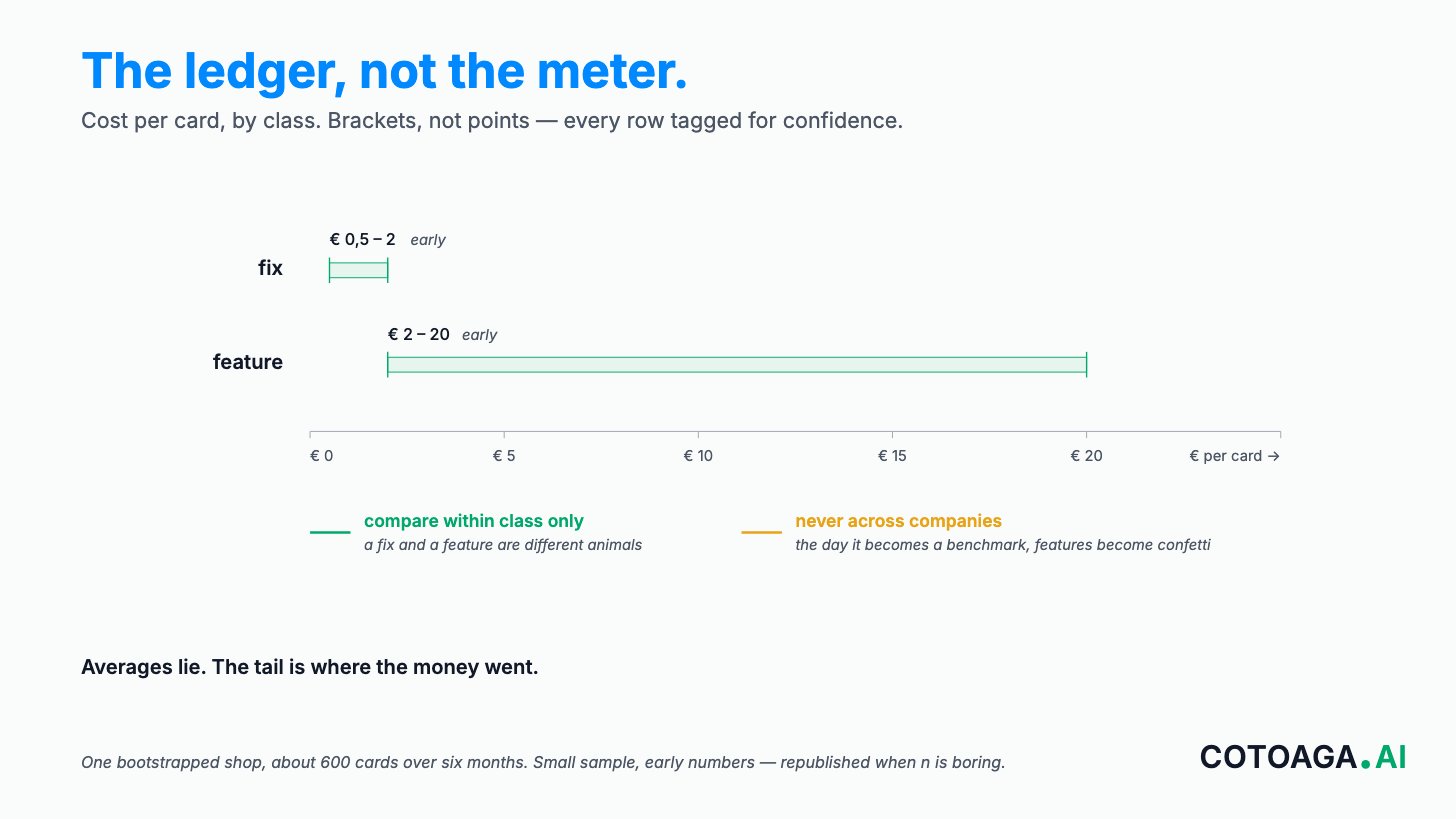
I run a bootstrapped shop, so I can show mine. About 600 cards over 6 month. A fix lands between €0,5 and €2. A feature between €2 and €20. The averages are useless; the tail is where the money went. Small sample, early numbers, brackets not points. I’ll republish when the n is boring.
Two rules that keep the ledger honest
Compare only within class. A fix and a feature are different animals: trend fix against fix, feature against feature, and the moment you blend them the number lies. The foundation arrived at the same idea from the other side and calls it Big-T Notation — classify the workload before you compare the cost. Good name. Move on.
Never compare across companies. The day cost-per-feature becomes a benchmark, features become confetti — smaller, more numerous, cheaper each, worth nothing. Your ledger is for your planning game. It is not for LinkedIn, and it is not for the investor deck either, except as the thing that lets you answer the question in the first paragraph.
Where this breaks
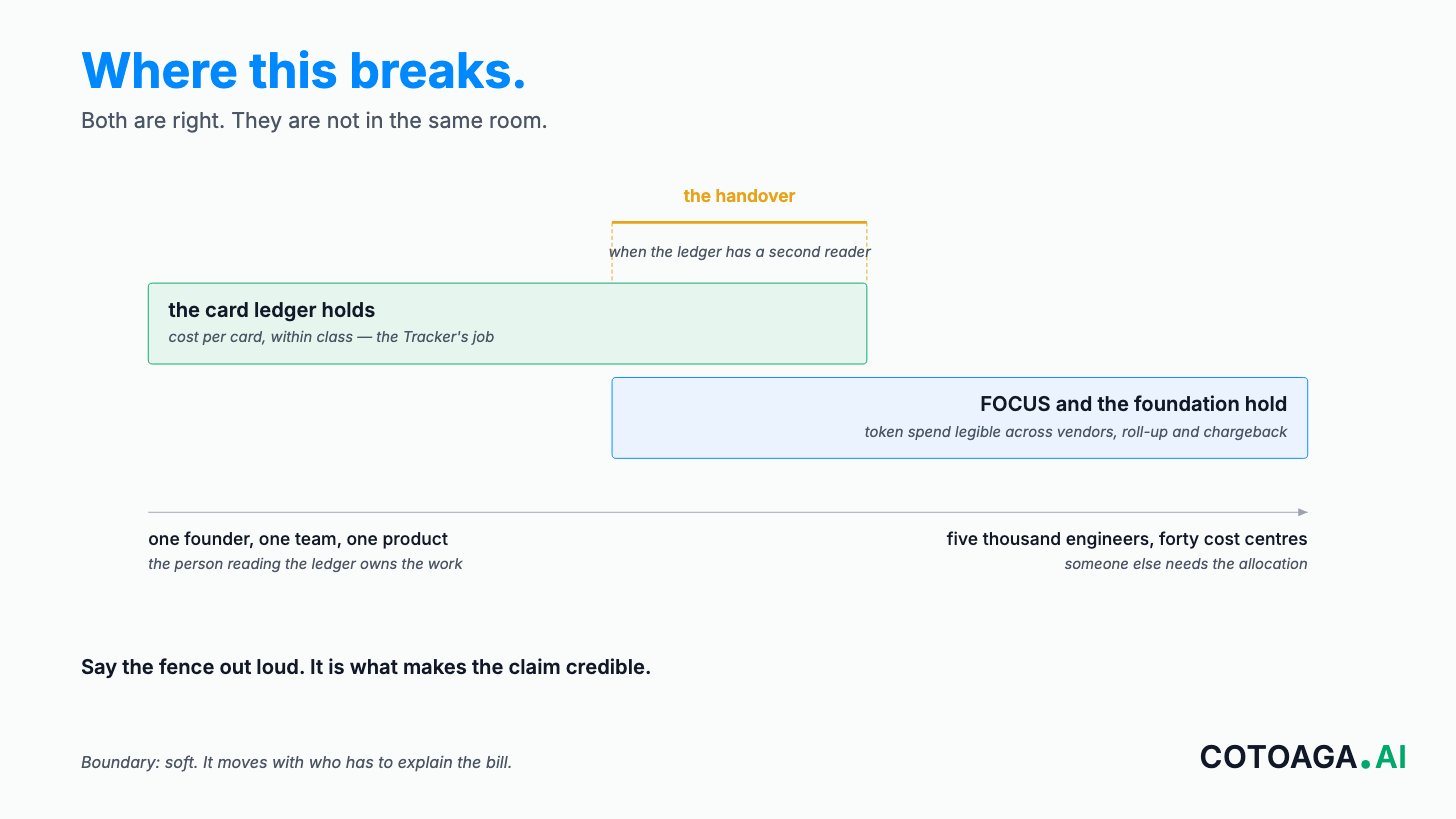
At five thousand engineers, with a CFO who has to allocate the AI bill across forty cost centres, the card doesn’t roll up and nobody wants it to. That is exactly where the foundation’s work is right, and why a bank sits among the founders. Below that line — one founder, one team, one product — the person reading the ledger owns the work behind it, and the card is enough. Both are right. They are not in the same room.
What not to do
Don’t buy the token dashboard first; it’s a meter, and you already have a meter. Don’t set per-developer token budgets — you’ll get people who ration thinking. Don’t let the seller’s unit become your KPI; they price it, they change it, and they will keep both of those rights. Don’t average. Don’t compare with anyone.
The other chair
Last time I asked who’s sitting in your customer chair. This time: who’s keeping your ledger? If the answer is the vendor’s dashboard, you’ve handed your books to the seller — and the seller keeps very good books.
First published on LinkedIn, 18 Sep 2026. This edition adds one illustration.
Created Updated