

Nur auf Englisch, mit Absicht. Deutsche Arbeit: Start →
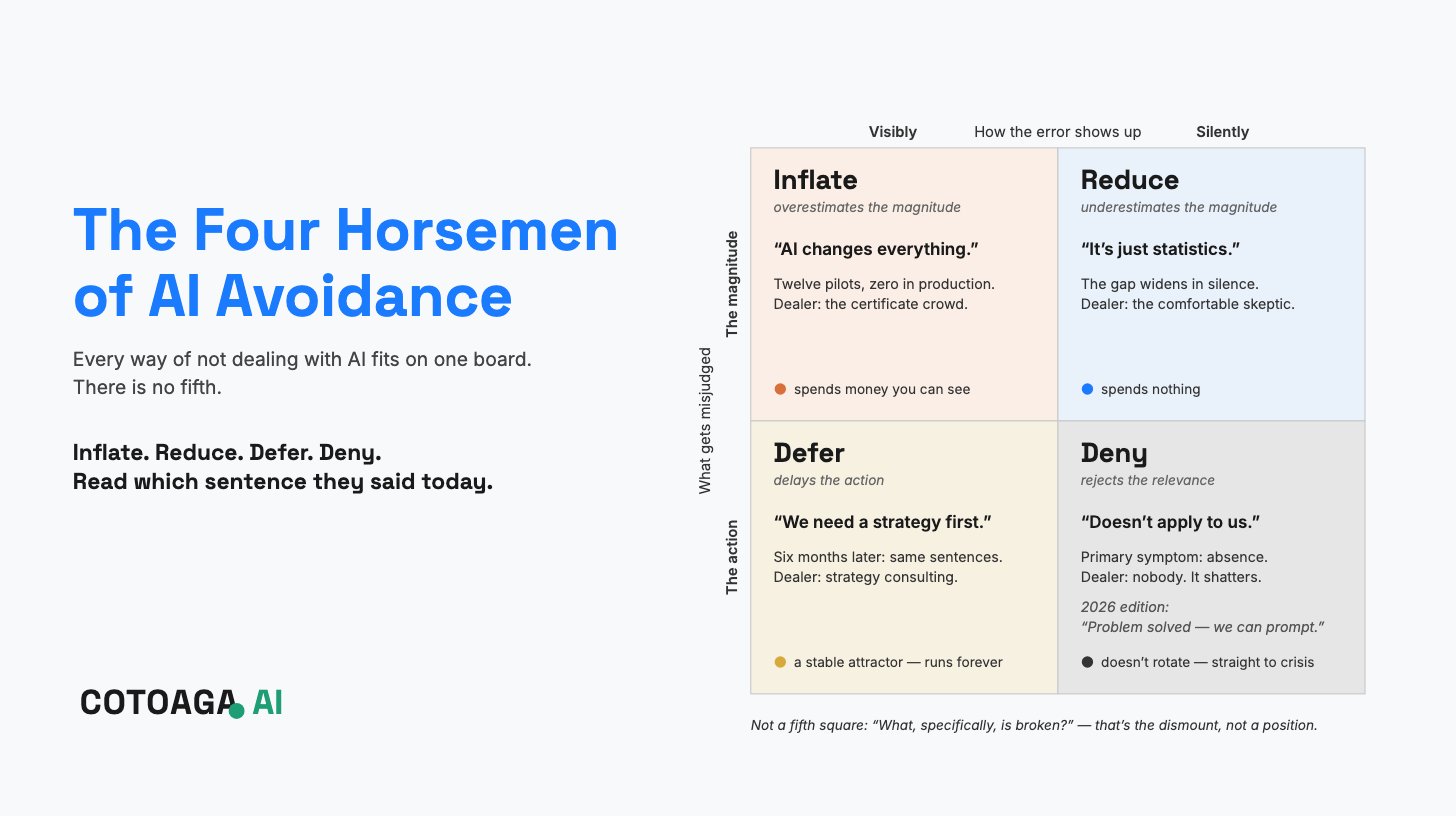
Every way of not dealing with AI fits on one board. There is no fifth.
A consultant once told me he talked himself out of an assignment with a single question. The executive across the table had opened with "morale is in the pits." The consultant asked: how do you know you have a problem? The honest answer, after some digging, was that three key people had complained about compensation. Three people. Specific, small, fixable. The generalization — morale is in the pits — was not a description of the company. It was a description of how the executive felt about three conversations.
I've watched the same move happen with AI in dozens of rooms, and the interesting part is not that people generalize. Everyone does. The interesting part is that the generalizations are not random. They come in exactly four flavors, each with its own internal logic, its own emotional payoff, and its own dealer waiting outside the door with something to sell.
I call them the Four Horsemen. Not because the world ends — it doesn't — but because each one rides away from the one thing that would actually help, which is a specific answer to a specific question.
Here they are.
1 · Inflate — "AI changes everything"
The sentence: KI verändert alles. AI transforms our entire industry. We need an AI strategy for everything. In five years we won't exist if we don't act.
The logic: If AI changes everything, any action is justified and no specific action can be wrong. You cannot fail at "everything," because there is no measurable target. Inflation is a shield against accountability wearing the costume of ambition.
The payoff: Visionary excitement. The Inflate rider feels ahead of the curve. Conference keynotes reinforce it hourly. Being the AI champion in the leadership team feels good, and it is supposed to feel good — that's the mechanism.
What it produces: Pilots without success criteria. Budget for "AI initiatives" attached to no problem. Twelve proofs-of-concept running in parallel, none reaching production. An innovation lab, carefully separated from the business it was meant to change. Every vendor pitch gets a meeting, because we need to explore everything.
I think of this as the pilot graveyard. Each grave was individually defensible. The cemetery as a whole makes no sense.
The cost, by kind: Visible waste — this is the horseman that spends money you can see. Then exhaustion: not another AI project. And a delayed-action poison: when the pilots fail, the story becomes "AI doesn't work for us," which feeds two of the other riders.
The dealer: The certificate crowd. Sixty minutes to AI-readiness, transformation kickoffs, the workshop that ends with a diploma and a group photo. They need Inflate to exist, because Inflate never asks the specific question that would expose the diploma as paper.
How it rotates: Inflate collapses into Defer when the first pilot fails ("okay, we need a strategy first"), or into Reduce when the conference high wears off and the CRM is still broken.
2 · Reduce — "It's just statistics"
The sentence: Das ist doch nur Statistik. It's just ones and zeros. We had rule-based systems in the nineties. The expertise stays with the human; AI is only a tool. Our processes are too complex for this. We know our customers better than any machine.
The logic: If AI is reducible to something already understood — statistics, automation, pattern matching — then nothing fundamental has changed. Existing mental models remain valid. Existing authority remains intact. The threat is neutralized by reclassification.
The payoff: Intellectual superiority. The Reduce rider feels smart, grounded, immune to hype. There is deep comfort in "I understood this already — it's just [familiar thing] with better marketing." Competence is preserved. The terrifying unknown becomes a manageable known.
What it produces: AI treated as a tooling decision and delegated to IT. No investment in understanding what is actually different this time. Competitor deployments dismissed as marketing stunts. And the quietest failure on the board: capability gaps that widen silently, because nobody is measuring the delta. The people inside the organization who do see the shift get frustrated and leave.
The cost, by kind: Almost nothing you can see — that's the point of Reduce; it doesn't spend. The cost is the silent gap, compounding month over month, invisible until a competitor does something nobody in the room can explain.
The dealer: The comfortable skeptic. Not the academic who actually understands the technology and gatekeeps through complexity — that's a different figure, and an honest one. The comfortable skeptic doesn't understand it and gatekeeps through dismissal. "AI is overhyped" content performs beautifully because it tells the Reduce rider exactly what they already believe. Validation for inaction is a product too.
How it rotates: Reduce collapses into Deny when the dismissal becomes total, or snaps into Inflate when a board member returns from Davos demanding an AI strategy by Q2.
3 · Defer — "We need a strategy first"
The sentence: Wir brauchen erst eine Strategie. Before we act, we need a clear plan. We're waiting for regulatory clarity. Our consultant is preparing a position paper. Next quarter we'll know more. We're still evaluating.
What it sounds like six months later: the same sentences, verbatim.
The logic: If the strategy isn't complete, any action is premature. Deferral looks like responsible leadership — we're being thoughtful, not reactive. In cultures that prize thoroughness (the German word is Gründlichkeit, and it is a virtue), moving without a finished plan feels reckless. There is a deeper payoff underneath: as long as the strategy isn't finished, no decision can be wrong, because no decision has been made.
What it produces: Two-hundred-page decks. Maturity models. Evaluation cycles that compare tools instead of solving problems. Regulation recast as a reason to wait rather than a frame for action. And every quarter, a revised timeline that pushes action one quarter further out.
Defer is the most dangerous of the three visible riders because it is self-reinforcing. Every month of deferral adds new inputs — new rules, new tools, new competitor moves — which justify further deferral, because the landscape is changing too fast to commit. The strategy never finishes because the inputs never stop. This is a stable attractor. Without an external shock, Defer runs forever.
The cost, by kind: Compounding delay. Every month the strategy is refined is a month someone else spends deploying. And a cultural one: "waiting for the strategy" becomes the default answer to any AI question at any level of the organization.
The dealer: Strategy consulting. The deck, the roadmap, the maturity model, the evaluation framework. Their engagement model requires long evaluation cycles. A client who says "just fix the CRM" doesn't need a strategy. They need a mechanic. Nobody sells mechanics by the hundred-page.
How it rotates: Defer collapses into Deny when the strategy process exhausts everyone ("let's focus on core business"), or flips into Inflate when leadership changes and the new CTO wants visible AI initiatives immediately.
4 · Deny — "Doesn't apply to us"
The sentence: Betrifft uns nicht. Our industry is too specialized. Our customers want personal contact, not AI. That's for tech giants, not for companies like ours. We have other priorities. We work fine the way we are.
And, most often: silence. The Deny rider isn't in the conversation at all.
The logic: If AI doesn't apply to our business, our scale, our geography, no response is required. Denial is the most energy-efficient avoidance strategy ever devised — zero investment, zero attention, zero emotional labor. The threat doesn't exist.
The payoff: Peace of mind. Complete peace of mind. No fear of missing out, no urgency, no budget fights, no uncomfortable conversations. The Deny rider sleeps well. Their world is coherent and unchanged.
The detection problem: Deny is the hardest horseman to see because its primary symptom is absence. The Deny rider doesn't attend the events, doesn't comment on the posts, doesn't commission the evaluations, doesn't show up in anyone's data. Roughly half of humanity still hasn't touched an AI system in any form; not all of them are Deny riders, but every Deny rider lives in that half.
What it produces: Business as usual. No literacy, no experimentation, no data infrastructure, no muscle. Market shifts get attributed to other things — pricing pressure, competition, "market conditions." When the impact finally arrives, it arrives as a crisis, not a transition.
The cost, by kind: Nothing, until everything. That's the trap. The direct cost is zero right up to the moment the bill is total.
The dealer: Nobody. This is the critical difference between Deny and the other three. Nobody sells to Deny, because Deny isn't buying. Deny is unreachable by marketing, content, consulting, events, or articles like this one. The only sales force that ever converts a Deny rider is the market itself — a competitor, a customer, a regulator forcing the issue.
How it rotates: It doesn't. Deny shatters. When reality finally penetrates, the Deny rider doesn't cycle through evaluation. They go straight to crisis. They need everything — literacy, tools, decisions, implementation — simultaneously, and they needed it last year.
Deny, 2026 edition
Deny has an upgrade, and I only noticed it because I ask the same question every year.
In 2025, when I asked decision-makers what they were doing about the EU AI Act, the answers came in two dialects: which act? and doesn't apply to us. Both wrong. Both operable — they held because nothing tested them. Two dialects, one horseman: Deny before contact, Deny after contact.
In 2026 the answer is a single sentence: problem solved — we can prompt, but thanks for asking.
This is not a fifth horseman, and it is not a new position on the board. It's Deny that has learned the vocabulary. The old rider denied the relevance; this one denies the gap. Same structural move — reject the action as unnecessary — in a much better disguise, because it now speaks fluent AI. Underneath it is a casual user with a tool subscription who believes the subscription is the competence.
And it is more dangerous than the 2025 version, because regulation can't shatter it. The old Deny could be broken by a paragraph of law that says yes, you. The new Deny already says it complies — it prompts, it has done the workshop, literacy handled. The only thing that shatters it is the first invented value that reaches a signature.
The rotation
The four are not personality types. They're not stable positions. They're current states, and they rotate — sometimes within a single week.
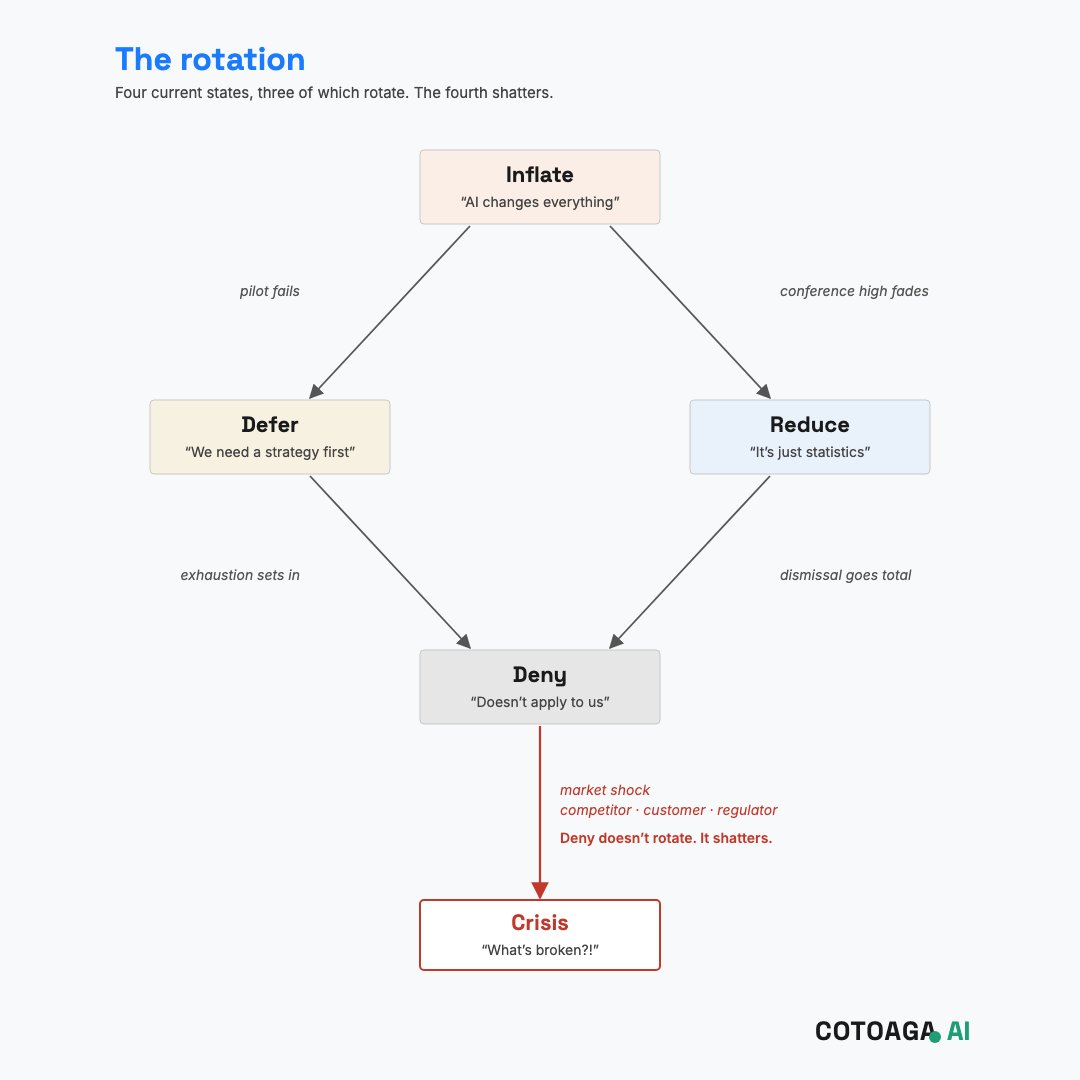
A week I've watched more than once:
Monday, after the conference: Inflate. We have to act.
Wednesday, after the board meeting: Defer. But first we need a plan.
Friday, after the pilot underdelivers: Reduce. It's all hype anyway.
Underneath, all week, the quiet hum: this doesn't really concern us.
Which is why diagnosing someone's horseman is never a one-time assessment. It's reading which sentence they said today.
Why four, and not three or five
I resisted this taxonomy for a while, because tidy fours are usually a sign that someone wanted a slide. Then I tried to find the fifth horseman and couldn't.
Any response to a disruptive technology that isn't engagement makes two errors at most. You can misjudge the magnitude — overestimate it or underestimate it. And you can misjudge the action — delay it or reject its relevance altogether.
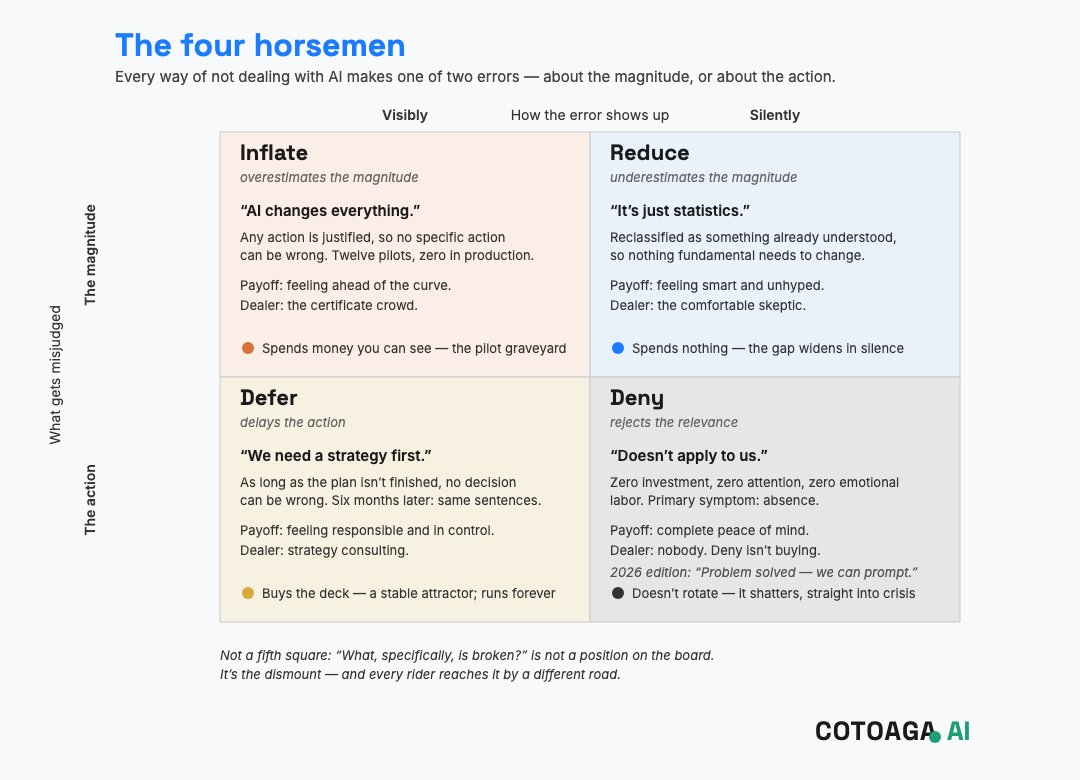
Every apparent fifth I've been offered turned out to be a blend, a rotation, or — as with the 2026 edition above — an old rider in new clothes. "Cautious optimism" is Inflate with a Defer chaser. "Pragmatic realism" is usually Reduce wearing a nicer jacket. The four cover the space. Two dimensions, two poles each, done.
The board also reads left to right in a way I didn't design and can't unsee: the left column spends and the right column doesn't. Inflate and Defer make errors you can see — pilots, decks, invoices. Reduce and Deny make errors that are silent until something outside forces them into view. The visible errors are cheaper to diagnose and more expensive to run. The silent ones are the reverse.
The combinations are instructive too. Overestimate-plus-delay — Inflate rotating into Defer — is the most common path, and the one most consultancies are built to monetize. Underestimate-plus-reject — Reduce sliding into Deny — is the most dangerous, because it's silent until it shatters.
Where the riders live, and what they buy
Two things I've written before line up with this board more neatly than I expected, so let me connect them rather than pretend each framework stands alone.
Where they live. In The AI-Literacy Pyramid I mapped where people actually stand with AI, from the untouched half of the world through casual users, paying users, builders, and the tiny orchestration layer at the top. Each horseman is a level-transition failure. Inflate is the casual user who believes they're a builder — superficial exposure inflated into capability. Reduce is the paying user who defines the next level out of existence: it's just a tool, so there's nothing further to understand. Defer is the casual-to-paying user delegating every decision upward to "the experts" — learned helplessness disguised as prudence. Deny is the untouched half choosing to stay untouched. The pyramid tells you where someone stands; the horsemen tell you which direction they'll flinch when you ask them to move.
What they buy. In Where Accountability Cannot Migrate I put every AI business position on a 2×2 — what you answer for, against what you're priced on — and argued that only one square holds under pressure. The horsemen turn out to be a buyer's map of the same board. Inflate buys off the board entirely: seat-priced tools and copilots, a dozen of them, none of which answer for anything. Reduce refuses to see the board at all — it's just a tool is precisely the claim that liability doesn't exist. Defer buys the deck: priced on labor, answering for nothing, which is the one thing no one on the board can be held to. And Deny buys nothing — until the shatter, at which point the Deny rider walks in as the most exposed customer in the market, willing to pay anyone who promises an outcome, which is how organizations end up in the worst square as clients rather than vendors.
The accountability matrix says where a vendor can stand. The horsemen say which vendor each rider is about to fall for. Same board, opposite side of the table.
The one thing regulation does that nothing else does
There is exactly one external force that hits all four riders at once, and it's the EU AI Act — specifically the literacy obligation in Article 4, which requires organizations deploying AI to ensure their people have sufficient AI literacy.
Watch how each rider metabolizes it. Inflate adds compliance to every pilot — more scope, less focus. Reduce reads regulation as proof of overhype. Defer gets fresh fuel: we're waiting for final guidance. Deny says it doesn't apply, which is the one thing Article 4 is written to contradict.
I don't sell fear about fines, and I'd distrust anyone who does — that's Inflate's crouch turned inside out. But regulation has one property the horsemen can't absorb: it doesn't care which horse you're on. It is the rare input that produces a specific obligation for the organization that has been avoiding specificity in four different ways.
The fifth that isn't a horseman
Everyone who reads this asks where the good position is. Where's the fifth quadrant, the one for organizations that get it right?
There isn't one, and naming it would be the mistake. The horsemen are defined by what they avoid. The alternative isn't a quadrant. It's a question — the consultant's question, the one that lost him the assignment: how do you know you have a problem? And its working form: what, specifically, is broken?
The moment someone answers that with a noun and a number — three people, one process, this contract, that Friday afternoon — they have dismounted. It doesn't matter which horse they were on. The method of getting off differs (validate the urgency and narrow it; respect the expertise and show the gap; honor the thoroughness and price the delay; wait, and be findable), but the destination is the same every time: specific problem, concrete action, something you can measure by the end of the month.
The horsemen aren't the enemy. They're the four roads people take to that question. The only real failure is riding in circles so long you never arrive.
Inflate, Reduce, Defer, Deny. Read which sentence they said today.
— Kurt Cotoaga, cotoaga.ai
First published on LinkedIn, 15 Sep 2026.
Created Updated